“Loyalty to my people means more to me than my properties or my life.” Jan A. Baťa did not speak aloud, because he could not risk the lives of those who could not speak for themselves. That silence, misunderstood then, demands recognition now.
The author of the text bears full responsibility for the information provided on this page. European Justice Organization z.s. only provides a publishing account for independent journalists and is not responsible for the content or the sources cited.
Protecting a Quarter-Million Lives Through Strategic Silence
By John Nash
Juli 23, 2025
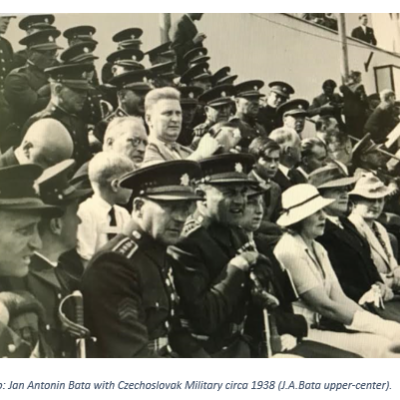
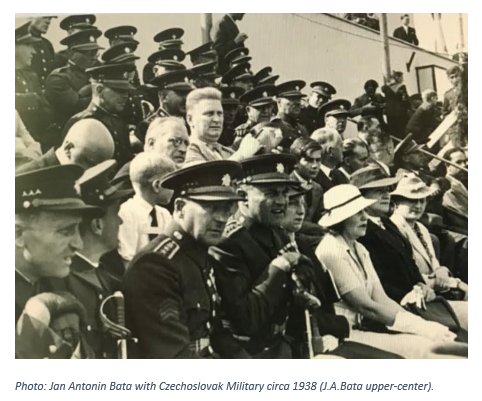
Photo: Jan Antonin Bata with Czechoslovak Military circa 1938 (J.A.Bata upper-center).
The Moral Burden of Leadership
During the Second World War, Jan Antonín Baťa, the head of one of the largest industrial empires in Central Europe, faced an impossible ethical dilemma. From his exile abroad, he was urged by the Czechoslovak government-in-exile and Allied authorities to publicly denounce the Nazi regime. He refused. Not out of fear, political ambivalence, or complicity, but from a deeply held sense of duty to the approximately 250,000 people who depended on the Baťa organization for their survival. In an unpublished 1941 memorandum titled "Loyalty to My People," Baťa outlines his rationale for what would become one of the most consequential silences of the war. This silence was not passive. It was protective, strategic, and ultimately humanitarian.
A public statement would have triggered retaliation from occupying forces against the very guarantors who had vouched for him upon his departure from Czechoslovakia in 1939.
Even before the war officially began, Jan Antonín Baťa—already operating under a proxy system from abroad—had instructed his directors and managers to quietly resist the encroaching occupation. In the earliest phases, he directed trusted representatives such as Bata a.s. director Cipera to establish discreet lines of communication with the Czechoslovak government-in-exile in London, including through the delivery of technical and industrial experts within days of request. These connections would later serve both intelligence and humanitarian purposes. From his post in Washington, D.C., Baťa continued to issue guidance—ordering that assistance be given to individuals seeking to escape Nazi-controlled territory, and on another occasion, directing the protection and employment of students, professors, and other professionals who had been dismissed or disenfranchised by the regime. These orders were part of a broader effort to leverage the Baťa organization’s vast infrastructure as a shield for human lives and a quiet instrument of resistance.
Protecting the Quarter-Million: Baťa's Calculated Absence
Baťa opens the letter with a clear articulation of why he left Czechoslovakia in June 1939. His departure was designed as a shield. With the Nazi occupation of Bohemia and Moravia imminent, Baťa calculated that his absence would allow the enterprise's domestic managers to deflect German pressure by citing his unavailability. In his own words:
“My absence should therefore be a kind of protection for them and for the enterprises.”
At the time, the Baťa enterprise directly employed approximately 60,000 individuals. With dependents, and partners and suppliers, the number of lives tied to the company reached roughly a quarter of a million. These figures framed Baťa’s moral calculus: a public denunciation of Nazism would not merely risk his life or his property, but might ensure the annihilation of Zlín’s economic base and the execution of the very guarantors left under Nazi occupation.
Rejecting Jan Masaryk: Public Gesture vs. Private Responsibility
Baťa identifies Jan Masaryk, the Czech Minister of Foreign Affairs in exile, as the principal advocate for a public statement. Masaryk viewed a public denunciation as a necessary symbol of loyalty to the Allied cause. Baťa, however, considered it performative and morally dangerous:
“It would be more comfortable and simpler for me to proceed according to Minister Masaryk’s request... But it would be irresponsible.”
To issue a statement would, in Baťa’s view, make him a “hangman of my guarantors.” He underscores that loyalty to people, not public performance, defines ethical leadership. His refusal is framed not as defiance of the exile government, but as protection of those still enduring life under occupation.
British Knowledge and Complicity Before the War
One of the most revealing aspects of Baťa’s letter is his assertion that several British officials had known of his plans and wartime strategy years before the war:
“I do not speak even of those British in London who have been informed about all whatever we did prior to our doing it... who have known our ideas for years before the war.”
When General Spears first visited Zlín in 1935, he likely recognized not just a well-organized industrial city, but a global enterprise that could be harnessed for strategic and political purposes. Spears—already a seasoned intelligence operative and deeply enmeshed in the imperial priorities of the British Empire—would later assume covert control over Baťa’s operations within its dominions. By the early months of the war, he had secretly taken control of all Baťa Shoe companies across the British Empire, appointing himself pro-tem Chairman in a move that was never formally approved by Jan Antonín Baťa. Notably, at the inception of the Special Operations Executive (SOE) in 1940, Spears was briefly appointed as its first Executive Director—a position reflecting the confidence placed in him to coordinate covert warfare, sabotage, and resistance networks across occupied Europe. Meanwhile, Alexander Frederick Whyte was installed as head of the Ministry of Information’s American Division, where he exercised strategic control over the British Empire’s propaganda operations in the United States. While simultaneously serving as a director of Baťa’s Tilbury operations, Whyte used his position to authorize and channel full-spectrum propaganda attacks against Jan Antonín Baťa—framing him as politically compromised and morally suspect. This orchestrated manipulation of American and Allied public opinion allowed for the legitimization of Baťa’s blacklisting and the imperial seizure of his assets. Whyte’s dual role—director of propaganda and director of a key Baťa subsidiary—formed a covert apparatus of political warfare that operated in direct opposition to Jan Baťa’s legitimate leadership in exile.
This admission turns the narrative of suspicion on its head. The British Ministry of Economic Warfare (MEW), which blacklisted Baťa in 1940, cannot claim ignorance. The blacklisting becomes, in Baťa’s view, not an act of precaution, but a betrayal of prewar understanding.
This reframing also calls for a broader understanding of heroism itself. Baťa’s wartime leadership challenges the conventional archetype of the exile who resists with speeches and salutes. His was an alternate heroism—quiet, logistical, and fiercely protective of the Baťa people. In place of slogans, he offered shelter. In place of dramatic gestures, he orchestrated escapes, issued orders, and refused to jeopardize a quarter-million lives for symbolic gain. His leadership operated beneath the surface, not because he lacked conviction, but because he bore the moral weight of consequence. This was resistance not as theater, but as responsibility.
Silence as Stewardship, Not Surrender
Throughout the letter, Baťa returns to a central theme: that silence, in this context, is not complicity but stewardship. Zlín, he writes, is only valuable to the Czech nation so long as it remains Czech. The people of Zlín—trained across three generations in the Baťa system—were the living infrastructure of national resilience. He warns:
“To give up Zlín now would signify to lose it definitely for the nation.”
He offers a counter-example: Kopřivnice, a Czech industrial town swiftly Germanized in six months after Munich. Baťa implies that a similar fate could await Zlín if the Germans seized full control in response to a political misstep.
Anticipating Vindication: The Invisible War Effort
Baťa predicts that the full extent of the Baťa organization’s contribution to the resistance will only be understood after the war:
“With all probability it will show that the handful of Batamen has spent the most of all groups of countrymen abroad.”
He positions the Baťa network not merely as a commercial structure, but as a silent ally of the resistance—facilitating escapes, managing funds, sheltering fugitives, and preparing for postwar reconstruction. He even references statements made by British diplomats that chillingly suggest sacrificing Czech collaborators would incite further rebellion:
“We want that they should shoot these guarantors in Czechoslovakia because only then the Czechs will rise up if they will suffer.”
Baťa refuses this logic. He will not authorize the deaths of his colleagues for political gain.
The Hidden Deeds of a Quiet Patriot
Though misunderstood and maligned in his time, Jan Antonín Baťa’s actions during the Second World War tell a different story—one not proclaimed through speeches or slogans, but embedded in silent, lifesaving infrastructure. His was a form of resistance expressed through factory payrolls, export manifests, coded telegrams, and discreet instructions. Often invisible in the moment, these efforts were indispensable to the survival of this indispensable Czech organization and its people.
Among his most consequential wartime actions:
The effort to protect Jewish employees and their families began in Zlín, where Jan Antonín Baťa coordinated a covert rescue initiative through Kotva and the Baťa Shoe branches centered in Zlín. Within Kotva’s import-export office, travel documents, passports, and emigration papers were quietly prepared for individuals facing Nazi persecution. From this operational base, Baťa issued confidential instructions to managers across the company’s global network to provide shelter, employment, and safe transit for those at risk. The infrastructure of Baťa factories, warehouses, and shipping lines—originating in Zlín—was quietly repurposed as a humanitarian pipeline. These efforts accelerated in the aftermath of the Munich Agreement and continued intensively through the end of 1939, ultimately aiding more than a thousand individuals in escaping occupied territories. Postwar testimonies and surviving internal correspondence confirm that this was a deliberate and centrally directed effort—one that transformed the Baťa enterprise into a hidden lifeline for the persecuted.
He orchestrated the export of industrial equipment, technical teams, and capital assets from Czechoslovakia to Allied and neutral nations including Africa, Brazil, Latin American, India, Singapore, Canada, and the United States. This denied Nazi Germany access to critical manufacturing infrastructure while ensuring that a functioning Czech industrial base survived abroad. Entire factories were recreated in exile, under Baťa’s supervision, with the intent of rebuilding the nation after liberation.
He supported the training of hundreds of Czech pilots, engineers, and specialists, many of whom joined Allied forces. Through Baťa’s aerodrome in Batov (today Otrokovice) his flight schools trained Czechoslovak hundreds of pilots and —preparing them for their later service in the Czech RAF.
Among his most far-reaching efforts was the sustained financial support he provided to the Czechoslovak government-in-exile, without which many of its essential operations abroad could not have continued. From offices in the United States, Canada, the United Kingdom, and India, Baťa’s resources underwrote administrative operations, diplomatic outreach, and material support. His British company funded the purchase of two Supermarine Spitfires for the Czechoslovak air force in exile, and he personally financed the reconstruction of the bombed-out barracks that housed Czech aviators in England. He also extended direct financial assistance to Edvard Beneš and his wife, and Jan Masaryk, ensuring their personal and political survival during critical wartime periods. These contributions have never acknowledged —but were instrumental in keeping the exile government operational and the Czech resistance abroad alive.
These were not side efforts. They were the backbone of Baťa’s invisible war: a resistance movement carried out through enterprise, logistics, and loyalty. He neither raised his voice nor abandoned his people. Instead, he transformed a global company into a shield for his nation.
His silence was not submission. It was his way of protecting his people.
Legacy of a Moral Patriot
In closing, Baťa affirms the love of homeland as the unifying force behind all his actions:
“Loyalty to my people means more to me than my properties or my life.”
The letter reveals a man unwilling to perform patriotism at the expense of lives. It outlines the moral solitude of an industrialist who bore the weight of national infrastructure, global suspicion, and political abandonment—yet continued to resist, protect, and prepare. It casts silence not as evasion but as ethical conviction, rooted in practical solidarity and historical foresight.
Jan A. Baťa did not speak aloud, because he could not risk the lives of those who could not speak for themselves. That silence, misunderstood then, demands recognition now.
***
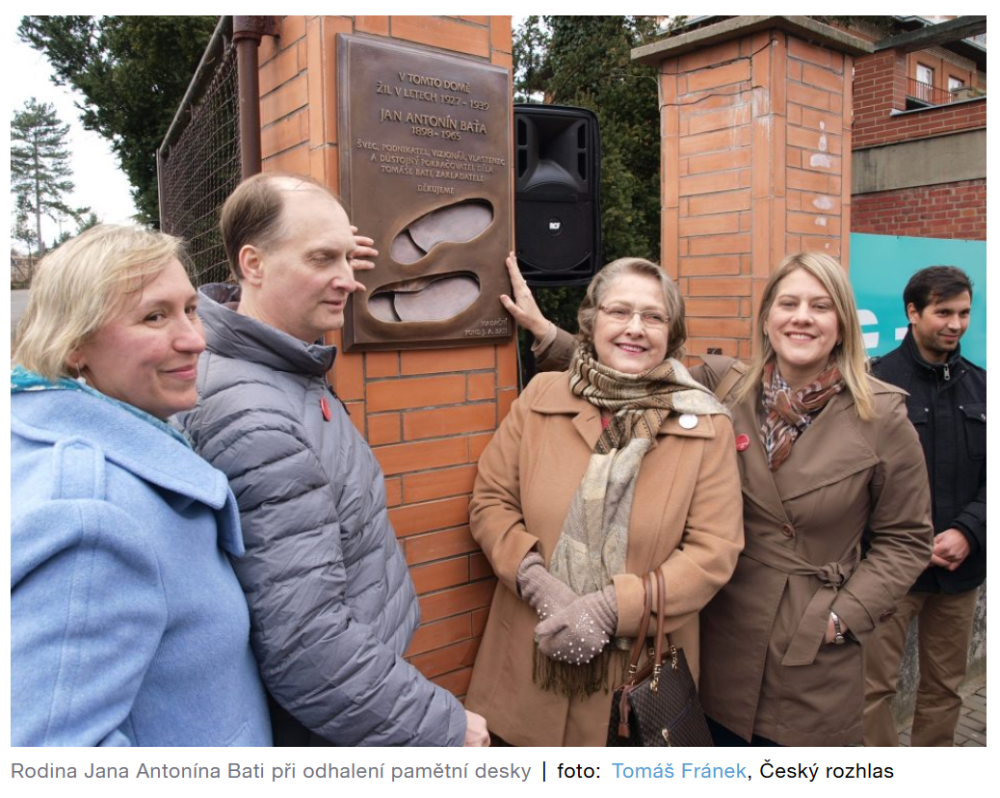
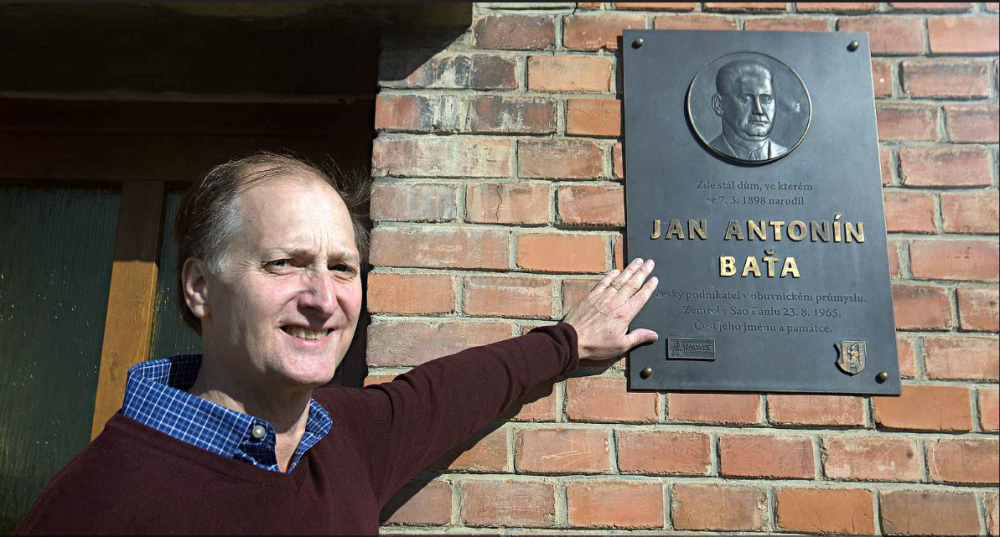
Within two years, a film about Tomáš Baťa is to be made for CZK 100 million, portraying him as an entrepreneur and, we hope, as a philosopher of life. His legacy is timeless and still relevant today. He did not recognize subsidies, only healthy competition and honest work. A TRILOGY should be filmed – the second part about JAN ANTONÍN BAŤA, when he and his colleagues led the company to prosperity (the largest company in Czechoslovakia and seventh in the world), and the third part about his CONVICTION, his life and work in Brazil (he was nominated for the Nobel Prize) and the still futile legal battles to recover his stolen, enormous fortune. What the Baťas have today in the Czech Republic, if anything, they had to buy. Jan A. Baťa received only an in memoriam award from the Czech Republic, the Order of the White Lion, First Class, on the occasion of the national holiday on October 28, 2019. Tomáš Baťa Sr. has not yet been honored. In 1991, his son Tomáš Baťa Jr. became a recipient of the Order of T. G. Masaryk, Second Class. The family villa of Jan Antonín Baťa in Zlín is now home to Czech Radio and the Czech Press Agency. Only a memorial plaque on the street, on a pillar at the entrance to the property, was permitted (March 9, 2018) ...
***
On August 7, 2025, the Ministry of the Interior of the Czech Republic decided that Jan A. Baťa's family villa would not be returned to his descendants! I quote from the Resolution on the postponement of the matter: According to the applicable legal regulations, it is not possible to issue the requested decision, or rather, no administrative authority is competent to deal with the applicant's submission. An article on the subject follows.
Tomáš Baťa Sr. was aware of the threat to the country. He therefore sold the company to his half-brother so that he could run for president of the Czechoslovak Republic. Unfortunately, he tragically lost his life. The history of our country could have taken a different direction, certainly not an eastern one.
Jan A. Baťa's grandson John Nash: "I think it is true that the Czechs lost their elite. Jan Baťa was an enemy of the elite, socialists, and communists. At the same time, he was on the side of his employees and his people. It was precisely because of his duty to the people that he was punished during the war and ultimately lost all his property. Imagine what the Czech Republic and Slovakia would look like today if Jan Baťa had been able to continue his work. It would be completely different. The Baťa company would probably be 100 times bigger and operate all over the world."
If a society produces such a "non-elite," it cannot be surprised that it does whatever it wants with society. Nor that even after eighty years, the state was unable to return the family villa (which belonged to Jan A. Baťa's wife). She was not a collaborator, nor was her husband. She fully supported him as a patriot, wife, and mother. Most politicians are not honest. They should be ashamed that for eighty years they tortured such a wonderful family that any developed country would be proud of.
The decline of honest work and moral values, as exemplified by the Baťas, is lacking in our country and the world today. Let us try to raise these values again together! This will also be an issue in the next elections. JŠ
To this day, we have not returned the stolen property to the descendants. They had to buy what they have. The family villa of Jan A. Baťa in Zlín is still home to Czech Radio and Czech News Agency. Only a memorial plaque was allowed!
Support independent investigations and the sharing of truth
Each of your contributions not only helps fund our work, but also supports the spread of this information so it can reach as many people as possible. Together, we can ensure accountability and justice, so the truth does not remain hidden. Thank you for your support!