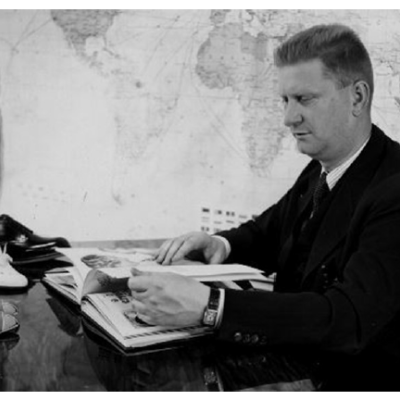
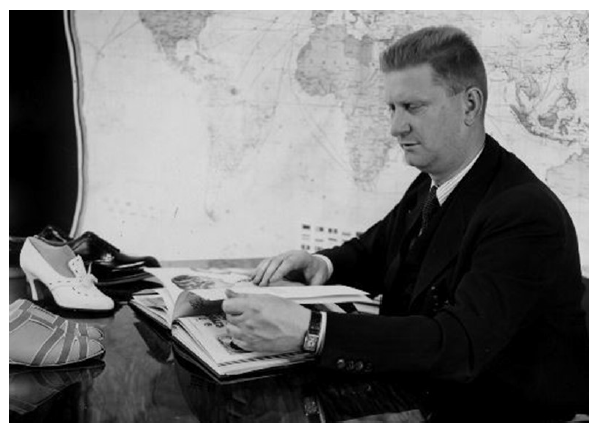
To this day, we have not returned the stolen property to the descendants. They had to buy what they have. The family villa of Jan A. Baťa in Zlín is still home to Czech Radio and Czech News Agency. Only a memorial plaque was allowed!
The author of the text bears full responsibility for the information provided on this page. European Justice Organization z.s. only provides a publishing account for independent journalists and is not responsible for the content or the sources cited.
The Man Who Fueled the Czech Resistance
By John G. Nash
July 23, 2025
In a letter dated October 4, 1945, written in exile to President Edvard Beneš, Jan Antonín Baťa laid bare his heartbreak and protest over the expropriaton of his life’s work-not out of selfinterest, but as a Czech patriot who had, for decades, served his country not only with words but with factories, livelihoods, and resistance. The letter is more than a defense of property - it is a powerful testmony to Baťa’s central role in building the Czechoslovak economy and covertly sustaining its wartme struggle.
„You know it was not the state who built these enterprises… Zlín was built to elevate the Czech worker.”
With this simple but cutng declaraton, Jan Baťa reminds Beneš that the prosperity of Czechoslovakia its industrial backbone and export might - was not the result of government policy, but of private initatve groundedin natonal pride. Baťa's enterprises, he notes, accounted for 7–10% of the country’s total exports during the most difficult prewar years. In a time when the Republic was young and fragile, Zlín was a model of self-sustaining progress.
But his contributon did not end with economics. Though Beneš's government kept Baťa on Allied blacklists, falsely implying collaboraton with the Axis, Baťa states unequivocally:
„Even though you cast me out—or at least let me to the shame of the blacklist, to your own detriment during this war—you know that… my people around the world supported your government-in-exile and the resistance with all their strength.”
And support they did. Baťa estmates that “two-thirds, or at least a solid half, of all contributons from Czechs abroad were made by my colleagues.” This was not exaggeraton. It was a staggering claim, given in full knowledge of its weight: that up to 66% of Czech resistence funding abroad came through Baťa’s global network - with his direct knowledge and consent.
One of the most poignant moments of the letter recounts the persecuton of Dominik Čipera, former mayor of Zlín and key wartme organizer:
„Čipera helped me out of prison before our transport was taken to Auschwitz—you know, to the gas chambers... And now? He lies in a hospital after being beaten by those who call themselves liberators.”
The leter contnues to connect the resistance effort with Baťa’s industrial power. The government, he reminds Beneš, had specifically requested that his factories produce essental war goods. And so they did:
„New enterprises, many of which were requested of me by the army (gas masks, chemicals, aircraft, machine works), and others required by the economy of the Republic (synthetic fibers, rubber, tanning agents, and more)...”
This wasn´t profiteering. Baťa stresses that “even as the owner, I let all of my earnings in the enterprise”, reinvesting not for personal gain but to make Czechoslovakia more self-reliant in
case of war. He called it “my form of patriotism—which I never saw in politcs.”
The leter ends not with bitterness, but with a sober warning and hearfelt appeal:
„I do not understand why I should now be repaid by having our enterprises expropriated… It is the Czechoslovak government that takes from my hands the tool of my service to the naton and to humanity.”
„I lack neither admiraton for your wartme achievements, nor enthusiasm to assist you… But I will not give up anything—neither in economic matters, nor in terms of my citzenship or natonal identty.”
Jan A. Baťa never renounced his belief in a free and prosperous Czechoslovakia. But the nation he helped build with factories, exported goods, jobs, and clandestine resistance turned on him in the name of revoluton.
His voice deserves to be heard not as that of an industrialist defending property, but as a patriot defending principle - and as the man who may have contributed more to the Czech resistence than any single individual, while being accused of betrayal by the very state he saved.
„One way or another, I will return to Zlín.”
He did not. But history can still bring him home.
Source: Baťa, J. A. Uloupené dílo: Román z průmyslového života. Pages 345–350.
"We shouldn't just look up to foreign business stars like Steve Jobs; we have our own role model in Baťa. We want to remind people of his story and use it to strengthen pride in our history. At the same time, we would like to encourage the younger generation in particular to start their own businesses and succeed through honest means, even today," he added, noting that Baťa is probably the only Czechoslovak whose name is known on every continent.
PS:
After the tragic death of Tomáš Baťa, his half-brother Jan Antonín Baťa led the company to prosperity. His life would also be a topic for a feature film. It should be followed by a trilogy, ending with the shameful condemnation of Jan A. Baťa by the communists, his work in Brazil (he was nominated for the Nobel Prize), and how we have still not returned the stolen property to his descendants. What they have, they had to buy. Jan A. Baťa's family villa in Zlín is still home to Czech Radio and the Czech News Agency. Only a memorial plaque was allowed! JŠ
Support independent investigations and the sharing of truth
Each of your contributions not only helps fund our work, but also supports the spread of this information so it can reach as many people as possible. Together, we can ensure accountability and justice, so the truth does not remain hidden. Thank you for your support!