This was not improvised; by 1938–39, the Baťa organization had established a structured rescue network that ultimately enabled thousands of people to escape during one of the most dangerous periods in modern history.
The author of the text bears full responsibility for the information provided on this page. European Justice Organization z.s. only provides a publishing account for independent journalists and is not responsible for the content or the sources cited.
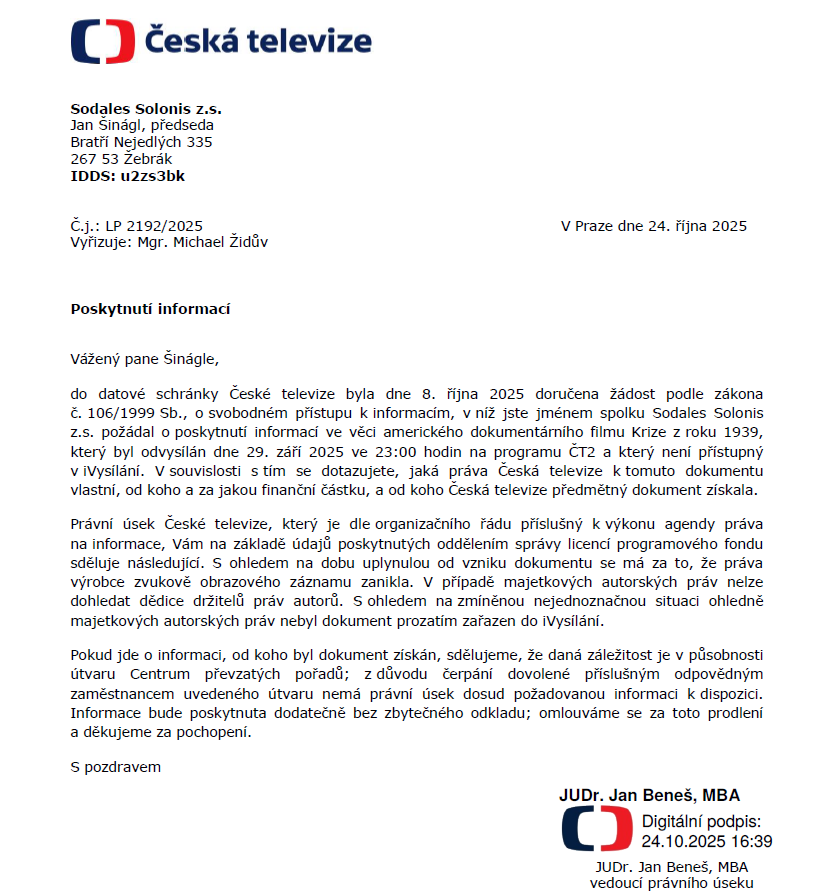
Updated October 27, 2025: Response from Czech Television regarding copyright – see attachment. JŠ
***
In March 1939, just days before Nazi troops marched into Czechoslovakia, a black-and-white documentary opened quietly at the 55th Street Playhouse in New York. Its title was Crisis: A Film of the Nazi Way.
In 66 electrifying minutes, it exposed Adolf Hitler’s calculated dismantling of a democratic nation. American audiences—accustomed to distant headlines and diplomatic platitudes—were suddenly confronted with gas-mask drills, refugees on the roads, and the betrayal of Munich in images no newspaper could match.
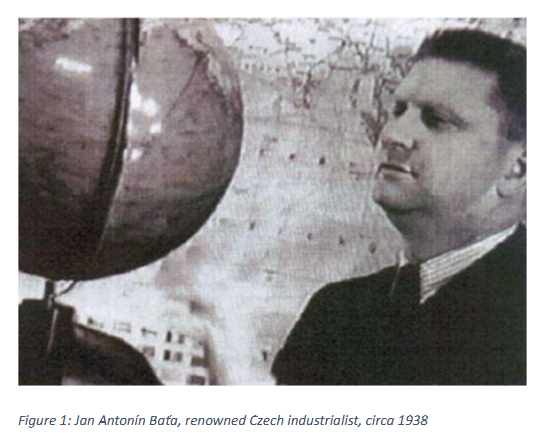
The film was hailed by critics as one of the year’s most powerful political works. The National Board of Review named it one of the “Top Ten Films of 1939.” But few realized then—or even now—that Crisis was not a Hollywood production. Its technical brilliance, logistical daring, and even its survival were the result of a covert collaboration within Jan Antonín Baťa’s industrial empire in Zlín.
Behind the film stood a modernist cinematic machine, a network of avant-garde filmmakers, and a corporate-political shield that together transformed what was essentially an industrial advertising studio into a weapon of resistance.
Baťa’s Modern Cinematic Arsenal
In 1934–35, Jan A. Baťa built a state-of-the-art film studio complex in the wooded hills of Kudlov, just outside Zlín. Officially known as Filmový Ateliér Baťa (FAB), the studios were created to produce industrial shorts, advertising films, and cultural documentaries for Baťa’s expanding global network.
This was not a small publicity unit. Baťa recruited some of the most talented young filmmakers in Central Europe—Alexandr Hackenschmied (later Alexander Hammid), Elmar Klos, and František Pilát—who brought modernist aesthetics and avant-garde techniques to the industrial environment. Kudlov’s facilities included synchronized sound stages, advanced editing rooms, a specialized animation department, and sophisticated montage capabilities that rivaled only a handful of studios were capable of producing.
By the late 1930s, this corporate film studio had become one of the most technically advanced in Europe—a remarkable achievement for what was, at its core, a shoe company. It was here that the raw materials for Crisis would be gathered, edited, and transformed into a cinematic alarm bell.
A Secret Collaboration Begins
As Hitler absorbed the Sudetenland in 1938, American filmmaker Herbert Kline and Czech journalist Hans Burger decided to make a documentary that would warn the world about the Nazi threat. They turned to Zlín for help.
Hackenschmied—by then Baťa’s chief cinematographer and creative engine—quietly agreed to work on the project. Under the guise of normal industrial and cultural filming, the Baťa film crew captured scenes of national mobilization, gas-mask drills at Baťa’s Fatra plant, and the daily rhythms of Baťa’s model industrial city.
Gas Mask Production and Strategic Relocation to France
One of Jan A. Baťa’s most ingenious pre-invasion moves was his quiet decision to relocate gas mask production out of Czechoslovakia before the Germans arrived. In early 1939, anticipating both occupation and the need to maintain supply lines to democratic allies, Baťa arranged for the transfer of specialized machinery and production from the Fatra plant in Napajedla to newly prepared facilities in France. This relocation—executed with speed and precision—ensured that critical civil defense manufacturing would not fall into Nazi hands. It also allowed Baťa’s network to continue supplying protective equipment to Allied and neutral countries just as Europe was sliding toward war. This was industrial strategy as national defense: a calculated act of resistance disguised as corporate logistics.
These sequences—modern factories, healthy uniformed youth, training exercises, and mobilization—would become the authentic backbone of Crisis. All were filmed on Baťa property, with Baťa cameras, lighting, and editing equipment.
Editing was conducted in secret in Kudlov’s cutting rooms. Turner Classic Movies would later note that the film was “edited in secret” at Baťa’s studios. The U.S. Holocaust Memorial Museum has confirmed that Crisis was never copyrighted—an anomaly reflecting its clandestine production and the urgency of its mission.
Hugo Vavrečka: The Strategic Shield
At the heart of this operation stood Hugo Vavrečka, a man whose unique dual role made Crisis possible.
Vavrečka was simultaneously a director of Baťa a.s., Zlín, responsible for the company’s international commercial affairs, and Czechoslovakia’s Minister of Propaganda in the government of Rudolf Beran. This unusual combination of corporate authority and ministerial power allowed him to protect the project on multiple fronts.
As Minister of Propaganda, Vavrečka oversaw national information and media policy. As a Baťa director, he controlled access to the Kudlov studios and the company’s vast global logistics network. He used this leverage to authorize the export of the film negatives under the harmless title “The Beauty of Czechoslovakia: A Cultural Film,” giving the smuggling operation an official veneer.
Vavrečka also ensured that Baťa’s film unit could operate without attracting Gestapo scrutiny, treating the project as a standard industrial documentary while shielding it politically. His role bridged the corporate and governmental spheres, creating a protective umbrella under which one of the most daring documentary productions of the era could proceed.
Super-Modern Animation: A Rare Weapon
One of Crisis’s most striking features was its use of animated sequences—a rarity in documentary filmmaking at the time.
These animated segments illustrated troop movements, political timelines, and strategic developments with striking clarity. In the late 1930s, producing this level of animation was technically difficult, time-consuming, and expensive. Few documentary filmmakers had access to such resources.
Baťa’s Kudlov studios were one of the few places in Europe where this was possible. Its dedicated animation department, usually tasked with stylish industrial shorts and advertising, was quietly reassigned to create bold political graphics for the film. The result gave Crisis a modern, persuasive visual language, far beyond what contemporary newsreels could offer.
These sequences are among the clearest fingerprints of Baťa’s involvement, turning the documentary into a cinematic weapon of political persuasion at a time when every frame mattered.
Smuggling the Film
By early 1939, as the occupation loomed, the project reached a critical point. The original negatives of Crisis were hidden and secretly flown to Paris, then shipped on to New York.
The smuggling operation relied entirely on Baťa’s transportation infrastructure, diplomatic contacts, and Vavrečka’s political authority. Without this shield, the film would almost certainly have been seized or destroyed.
Meanwhile, Hackenschmied—who had directed and edited much of the material—escaped to the United States, where he later worked for the U.S. Office of War Information, continuing the same mission under a new name, Alexander Hammid.
A Human Dimension: Werich — and Thousands More
The Baťa organization’s involvement in Crisis was not limited to filmmaking. It was also tied to a larger humanitarian operation that saved lives as Nazi control spread.
In spring 1939, Hugo Vavrečka personally arranged the escape of Jan Werich, one of Czechoslovakia’s most beloved comedians and a cultural figure associated with biting anti-fascist satire. Werich appears in Crisis performing on stage—a snapshot of cultural defiance on the eve of disaster.
His escape was made possible through Baťa’s well-organized system to help Jews, dissidents, and other endangered individuals flee the country. This was not improvised; by 1938–39, the Baťa organization had established a structured rescue network that ultimately enabled thousands of people to escape during one of the most dangerous periods in modern history.
This system included an internal passport and documentation office, capable of issuing travel papers and coordinating with sympathetic consulates; company funding to pay for travel, ship passages, and resettlement costs; transportation and communications infrastructure—from company cars and trains to overseas shipping lines—that could discreetly move people beyond Nazi reach; and a network of Baťa branches abroad, especially in neutral and Allied countries, ready to receive refugees as employees or dependents.
Through this machinery, Werich’s departure was arranged swiftly. Dozens of prominent figures and many thousands of Jewish employees and their families were assisted in similar fashion, often at Baťa’s expense. It was a humanitarian effort running parallel to the company’s industrial operations—quiet, efficient, and lifesaving.
The Film That Shook America
When Crisis premiered in New York in March 1939, the reaction was immediate. The New York Times critic Frank S. Nugent called it “one of the finest political documentaries ever made.” For many Americans, this was their first direct, visceral exposure to Hitler’s aggression and the betrayal of Munich.
The film’s combination of authentic footage, vivid animation, and emotional urgency cut through America’s isolationist mood. It presented Czechoslovakia’s tragedy with clarity and force at a moment when diplomatic warnings had failed.
Crisis would later influence Frank Capra’s Why We Fight series and stands today as one of the earliest
cinematic alarms against appeasement and fascism.
Conclusion: An Industrial Empire’s Quiet Defiance
Crisis was far more than a documentary. It was a covert act of resistance, made possible by the vision of Jan A. Baťa, the creativity of his filmmakers, and the strategic intelligence of Hugo Vavrečka.
Baťa’s modernist studios provided the technical power, including animated sequences that only a handful of facilities worldwide could produce. His global corporate network supplied the logistical escape routes. His trusted director—who was also Minister of Propaganda—provided the political shield. And behind it all was a humanitarian infrastructure that helped thousands of Jews and dissidents escape Nazi persecution.
Together, these elements transformed an industrial advertising studio into a cinematic and logistical weapon of conscience.
Few films have no copyright yet manage to change public awareness. Crisis is one of them. And behind it, though uncredited, stood Jan Antonín Baťa and the people of Zlín, whose ingenuity, courage, and humanity reverberated far beyond their factory town.
What Jan A. Baťa’s Film Studio Contributed to Crisis: A Film of the Nazi Way (1938–1939)
1.Filming Locations and Industrial Backdrop
The Kudlov/Zlín complex and Baťa’s modern industrial city provided key shooting locations.
Authentic scenes of factories, workers, gas-mask drills at the Fatra plant, and the Baťa School of Work were filmed on company property in Zlin using Baťa’s cameras, lighting, and infrastructure.
2.Camera Crews and Key Personnel
The principal creative force behind the film’s cinematography was Alexandr Hackenschmied (later known as Alexander Hammid), who by this point had been Baťa’s leading filmmaker and director since 1935.
Hackenschmied headed Baťa’s film department and had directed dozens of industrial and cultural films for the company over a four-year period.
Several Baťa camera operators and lighting specialists worked under his leadership, disguising their work as routine industrial filming.
3.Script and Narrative Development
Elmar Klos, one of Kudlov’s most accomplished directors, is documented in Czech sources (Stejskal, 1972) as having co-written or substantially contributed to the script of Crisis.
Klos’s role likely involved structuring journalistic material into a coherent cinematic narrative, crafting the script’s dramatic pacing, and coordinating editorial work within the studio.
The film’s montage-driven narrative and political clarity reflect Klos’s stylistic signature.
4.Editing Facilities and Post-Production
The entire editing process was carried out secretly inside Kudlov’s cutting rooms, using Baťa’s modern editing and sound synchronization equipment.
Turner Classic Movies confirms that the film was “edited in secret” at Baťa’s studios. This would have included assembly of sequences, integration of sound, and preparation of reels for export.
5.Super-Modern Animated Segments
Kudlov’s dedicated animation unit, usually employed for sophisticated industrial shorts and advertisements, produced striking animated sequences illustrating troop movements, political developments, and timelines.
This kind of animation was rare and costly in the late 1930s; few documentary filmmakers elsewhere had the capacity to produce such work.
6.Sound Recording and Synchronization
Kudlov’s synchronized sound stages were used for recording and preparing audio elements before final narration work abroad, ensuring professional production quality.
7.Political and Logistical Protection
Hugo Vavrečka, Baťa director and simultaneously Czechoslovakia’s Minister of Propaganda, acted as the project’s strategic shield.
He authorized the export of the film negatives under the innocuous title “The Beauty of Czechoslovakia: A Cultural Film” and ensured the studio operated under official cover, avoiding Gestapo attention.
8.Smuggling and Transport Infrastructure
Baťa’s extensive global transportation and communications network—including company aircraft, shipping, and diplomatic contacts—enabled the negatives to be moved safely to Paris and then New York, preventing Nazi confiscation.
Few films in history carry no copyright yet change the course of public awareness. Without Baťa’s resources, personnel, and approval, this landmark warning against Nazi aggression would never have seen the light of day.
Support independent investigations and the sharing of truth
Each of your contributions not only helps fund our work, but also supports the spread of this information so it can reach as many people as possible. Together, we can ensure accountability and justice, so the truth does not remain hidden. Thank you for your support!